Concentration and route
GHK-Cu study concentrations and delivery
A concentration describes a preparation. Its route and formulation determine what another experiment can reasonably borrow from it.
Published concentrations
The fibroblast collagen assay found stimulation beginning between 10^-12 and 10^-11 M, with a maximum at 10^-9 M. These concentrations surrounded cultured cells. Whole skin has a barrier between the preparation and those cells.
The topical literature reviewed for skin applications describes formulations at roughly 0.05% to 2% by weight. The trial in men instead used a GHK combination at 50 mg/mL and 100 mg/mL. Each number describes the substance and setting tested. The human hair study was a mixture, and the cell concentrations have no direct conversion into a human injection dose.
A tidy “GHK-Cu dosage” answer arouses my suspicion. The studies have already changed the substance, carrier and route before that answer begins. None of these figures establishes a personal treatment amount.
Copper in the skin apparatus
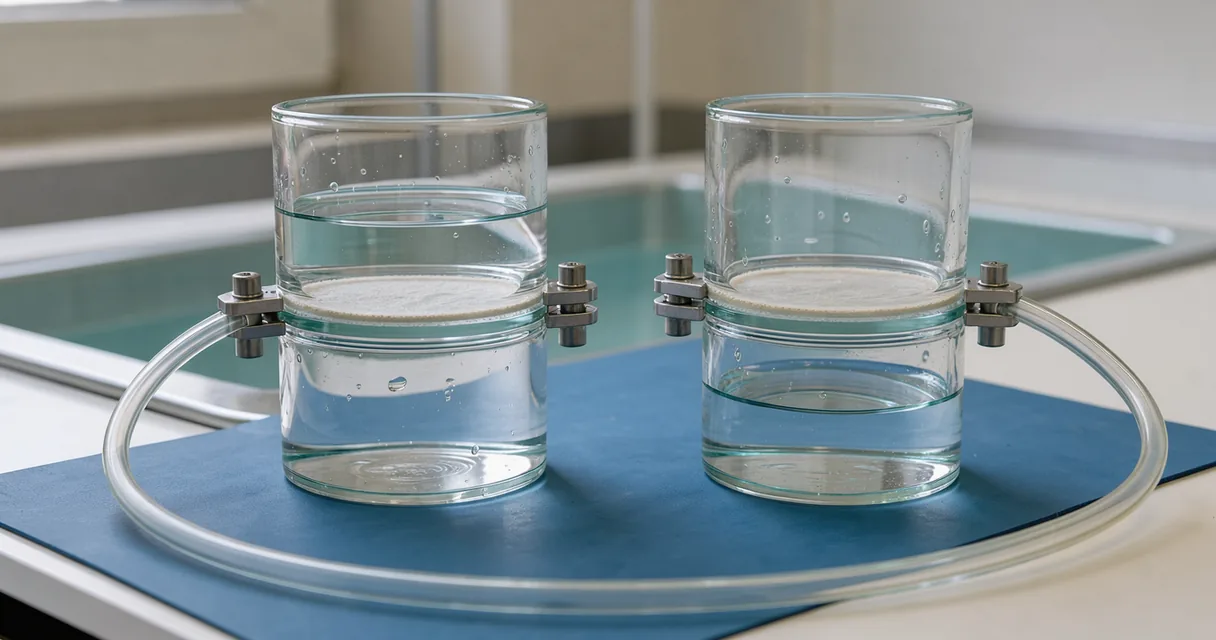
The 2011 skin penetration paper applied a copper tripeptide to removed human skin and measured copper passing through or remaining in its layers. After 48 hours, the skin retained 97 +/- 6.6 micrograms/cm^2. Permeated copper totaled 136.2 +/- 17.5 micrograms/cm^2.
The reported depot means copper remained in the skin under the test conditions. It supplies no duration of cosmetic benefit. It also tracks copper, leaving the fate of intact peptide as a separate question.
This practical problem deserves more attention: an ingredient has to get somewhere before its cell biology matters there. Liposomes, microemulsions and other delivery approaches are attempts to solve that problem. The liposome study tested carriers and epidermal cells; the microemulsion study included mouse hair growth. Their results travel with their preparations.
Rat blood and the half-life question
The 1997 rat pharmacokinetic study followed free GHK after intravenous administration and found rapid metabolism to histidyl-lysine. Pharmacokinetics is the study of where a substance goes and how the body handles it. Here, the subjects were rats and the starting compound was free GHK.
A validated human half-life for GHK-Cu remains unavailable. The reviewed material mentions a secondary estimate of roughly 1-2 hours for systemic elimination; that estimate has not been established in people. I'd exclude that estimate from any calculation intended to set a human regimen.
Fast disappearance of free GHK in rat blood and copper remaining in removed skin describe different substances, compartments and experiments. Together they explain the uncertainty rather well, without supplying the missing human measurement.
Treatment and approval status
GHK-Cu has no FDA-approved drug indication, and European therapeutic approval is also absent. Copper Tripeptide-1 has a permitted cosmetic role, described in the topical review. The prescription distinction remains relevant: a licensed clinician can prescribe compounded injectable GHK-Cu after assessing a patient; the compounded injection has no FDA approval.
Online injection protocols have no peer-reviewed human pharmacokinetic basis in the reviewed literature. Human dose selection requires evidence and individual medical assessment beyond what these pages can provide. I have no safe personal regimen to extract from this collection of experiments.
The remaining questions about systemic exposure are collected under copper accumulation and side effects.