Follicles and formulations
GHK-Cu hair growth study: ingredients and results
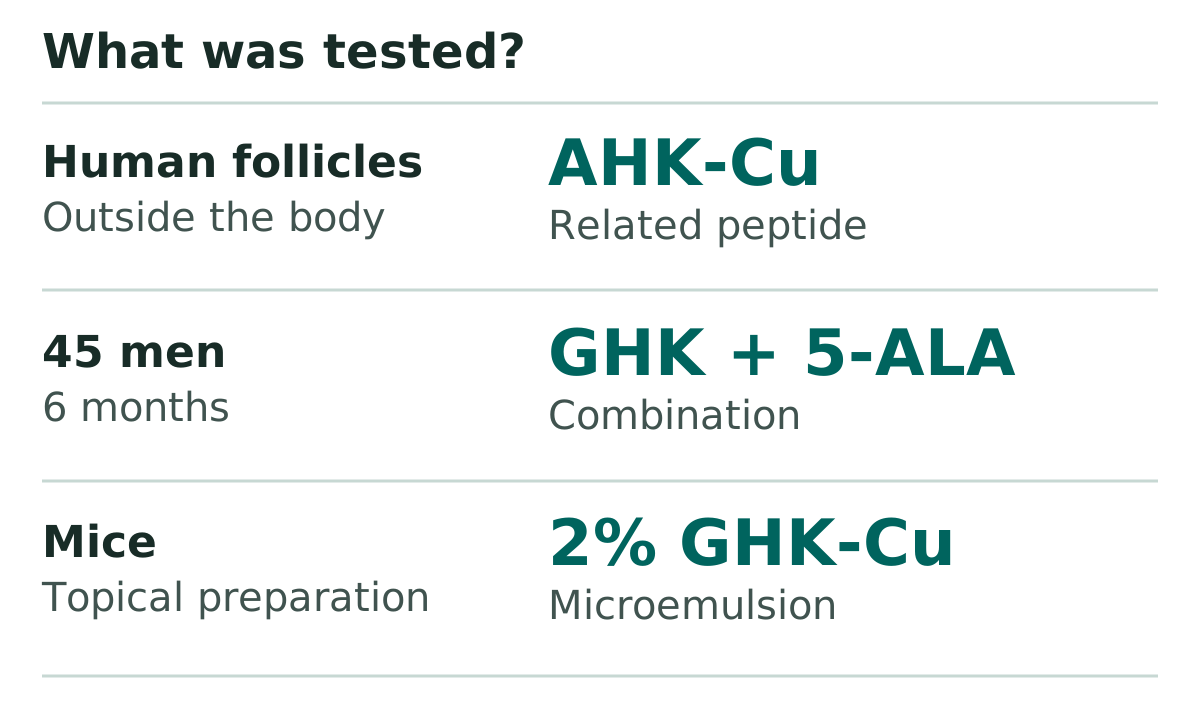
Copper peptide hair growth research contains an easily missed swap: isolated human follicles, men and mice received different preparations.
The effect of tripeptide-copper complex on human hair growth in vitro
That exact title is attached to a 2007 paper by Pyo and colleagues. The peptide was AHK-Cu, the alanyl analog of GHK-Cu. “Human” describes the origin of the follicles and cells; the follicles were studied outside the body, alongside cell cultures.
At 10^-12 to 10^-9 M, AHK-Cu stimulated follicle elongation. At 10^-9 M, dermal papilla cells, the cells at the base of a follicle that help direct growth, showed increased proliferation and reduced programmed cell death.
I nearly filed this under direct GHK-Cu evidence on the strength of its title. The ingredient changes that judgment. A related copper peptide produced an interesting human-tissue result, and GHK-Cu still needs its own corresponding demonstration. I'd happily see this experiment discussed more often, provided the AHK stays in the sentence.
The trial in men
The 2016 trial of 45 men with androgenetic alopecia followed a topical complex of 5-aminolevulinic acid and GHK for 6 months. Hair-count increases were 52.6 with the 100 mg/mL preparation, 71.5 with the 50 mg/mL preparation and 9.6 with placebo; the reported comparison was p<0.05. No adverse events were reported in any group.
The larger gain occurred with the weaker preparation. That is an awkward detail for any simple “more ingredient, more hair” story. It also concerns a combination: the study leaves each ingredient's contribution unresolved.
I take the counted hairs seriously. My condition is simple: name the combination every time those numbers appear. The result offers a reason to investigate a GHK-containing formulation; the small trial cannot isolate GHK's contribution or settle the long-term safety of a different preparation.
The mouse microemulsion
Earlier copper-peptide work in C3H mice supplied an animal basis for the hair-growth interest. The more recent ionic-liquid microemulsion study delivered 2% GHK-Cu topically to mice and reported anagen, the active growth phase, within 6 days versus 9 days with minoxidil. Hair density was higher at 28 days. Testosterone and estradiol were unchanged.
That experiment also examined Wnt/beta-catenin signaling and growth factors associated with follicles and blood vessels. Its formulation was designed to improve delivery. I regard the carrier as an ingredient in the result: the paper investigates a preparation getting to tissue as well as a peptide acting there.
The minoxidil comparison was in mice. It gives no direct human comparison and no date by which a person's hair will return. The unchanged hormones support a proposed growth pathway that differs from hormone blocking; they cannot establish that GHK-Cu blocks DHT in people.
Does copper peptide regrow hair?
The record contains follicle growth, mouse hair growth and a controlled human signal from a GHK combination. For copper peptide GHK-Cu hair growth evidence specifically, a larger trial of GHK-Cu alone would resolve a question the present papers leave open.
A useful next comparison would hold the carrier constant and distinguish GHK-Cu from that same carrier without it. I'd give that comparison priority. It would also need to count visible hair outcomes and follow adverse effects over time.
Reports of less shedding and thicker-looking hair on the personal-accounts page are anecdotal accounts, with other scalp treatments often involved. They add no controlled estimate of regrowth. The side-effects article deals with the remaining safety questions.