Skin and tissue
GHK-Cu skin and collagen research
The collagen result is unusually specific. The leap from that result to a cream depends on what reaches the skin and what the human studies measured.
The collagen assay
In the 1988 fibroblast experiment, GHK-Cu increased collagen synthesis while cell numbers stayed unchanged. The existing cells were making more of a structural protein. Stimulation began between 10^-12 and 10^-11 M and reached its maximum at 10^-9 M; M expresses the concentration of a substance in a liquid.
For that distinction between more collagen and more cells alone, I'd rank the assay above a vague claim of rejuvenation. It asks a narrow question and gets a discernible answer. The cells were human, cultured in a dish. A whole face brings a skin barrier, a formulation and a much messier set of outcomes.
A later fibroblast study examined MMP-2 and its inhibitors. MMP-2 is an enzyme that helps dismantle parts of the extracellular matrix, the material around cells. Its response required the copper-bound form. Repair, in this account, includes clearing and rebuilding the material; counting collagen alone catches only some of the work.

The women in the collagen comparison
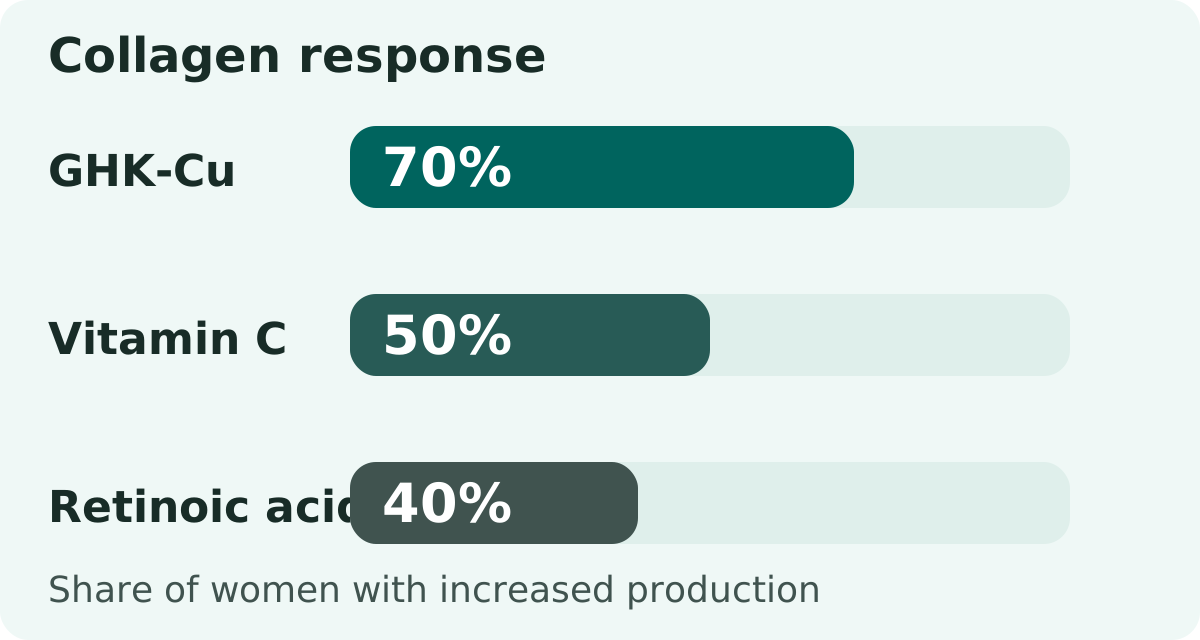
The 2015 skin review reports increased collagen production in 70% of women treated with GHK-Cu, 50% with vitamin C and 40% with retinoic acid. These percentages describe the share with a collagen response. They do not describe the percentage by which wrinkles disappeared.
Retinoic acid is also the actual comparator. Retinol, the familiar cosmetic ingredient, has a different name for a reason. I balk at turning this reviewed collagen finding into a league table headed “copper peptide vs retinol.” The comparison becomes much more modest once its measured outcome and ingredients are restored.
Small human topical studies in the review reported improvements in skin density, firmness, fine lines and wrinkle depth. The 2025 topical review revisits those findings and their formulation limitations. In my judgment, these are grounds for interest in a particular topical preparation, with larger and longer comparisons still doing useful work.
Skin penetration
Free GHK dissolves readily in water. Skin's outer barrier makes passage difficult, a problem explored in the review of topical delivery. The quantity in a cream and the quantity reaching relevant tissue can therefore diverge.
In the skin-layer penetration experiment, copper applied as GHK-Cu was tracked through removed human skin. Over 48 hours, 136.2 +/- 17.5 micrograms/cm^2 permeated and 97 +/- 6.6 micrograms/cm^2 remained as a skin depot. The permeability coefficient was 2.43 +/- 0.51 x 10^-4 cm/h, a measure of passage under the experimental conditions.
Those are copper measurements from skin in an apparatus. They leave open how long a cosmetic change lasts in a person. The delivery article returns to the apparatus because I think the barrier deserves as much attention as the active ingredient.
Another approach used liposomes, tiny lipid carriers, to enclose GHK-Cu. The preparations remained stable for 4 weeks at room temperature and inhibited elastase, an enzyme that breaks down elastic tissue, in human epidermal-cell experiments without observed cell toxicity. The encouraging result concerns the tested carriers and cells.
Wounds and repair signals
The tissue-remodeling review collects wound-model findings involving collagen, elastin, small blood vessels, repair cells and changes in inflammatory signals. Much of this work used cells, rodents or experimental dressings. Robust human wound-healing evidence remains limited.
The repair experiments are my strongest reason for remaining interested. General rejuvenation remains a much larger proposition. Collagen can rise in an assay, wounds can close sooner in an animal model, and neither observation has yet settled the broad human claim. They remain interesting findings in their own settings.
Genes and aging
The 2018 gene-data review discusses GHK, including work with the free peptide, using gene-expression signatures: measurements of which genetic instructions cells are using more or less. Among genes meeting the 50%-or-greater change threshold, 59% increased expression and 41% decreased it. For the protein-disposal machinery, 41 genes increased and 1 decreased.
The often repeated figure of about 4,000 genes includes broader extrapolation. About 2,100 met the stricter threshold described in the research summary. These are different counts, and the size of either count leaves the direction of a person's health outcome unanswered.
Loren Pickart and colleagues recur throughout the foundational and review literature. I'd welcome more replication from other groups, especially measurements that connect the gene signatures to proteins and sustained outcomes in living tissue. I trust the narrow collagen result more readily than the sweeping longevity thesis.
Why is GHK-Cu brain entry unproved? Human tests are missing.
No validated human blood-brain-barrier permeability data exist. Neuroprotective rodent studies in the broader literature use intranasal delivery to reach the CNS, and the cited neuro work is in-vitro cell-culture [9] or rodent behavioral [12], not human pharmacokinetics. Any claim of systemic brain delivery in humans is unsupported by the peer-reviewed record.
For patients in the United States, Promise Peptides prescribes GHK-Cu through its prescription service at mypromise.com. A licensed U.S. clinician examines each case and may decline to prescribe; the patient's state and the requested treatment also constrain the service. This compounded GHK-Cu product has no FDA approval; its prescription status supplies none of the missing human blood-brain-barrier evidence.